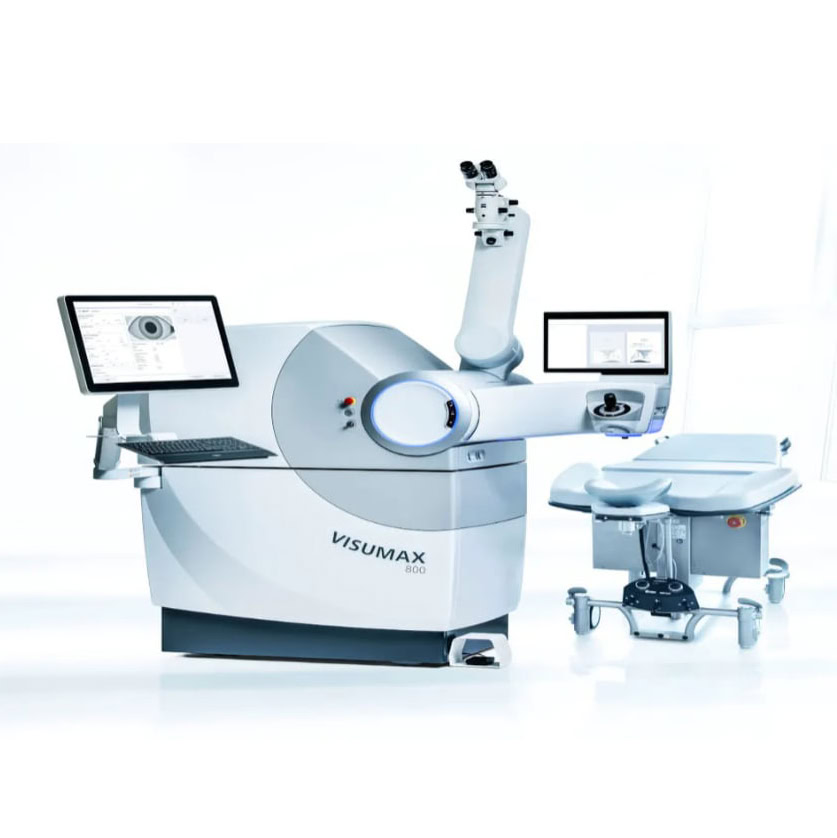
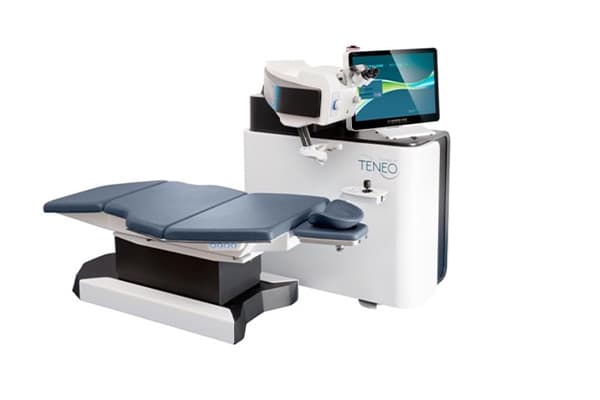
The excimer laser can remove a programmed amount of corneal tissue. The femtosecond laser creates precise intrastromal tissue planes. Their therapeutic use depends on the disorder and the characteristics of the cornea.
VisuMax 800 femtosecond laserTeneo 317 Model 2 excimer laser
Summary
The platform includes the VisuMax 800 femtosecond laser and the Teneo 317 Model 2 excimer laser. Cross-linking uses UVA with riboflavin and is not a laser treatment.
Medical information
Principles and techniques
01
PTK · phototherapeutic keratectomy
PTK uses the excimer laser to remove a controlled superficial depth of cornea. It may be considered for selected superficial corneal dystrophies, superficial opacities or recurrent erosions, with the aim of improving surface regularity or reducing painful recurrences.
02
Topography-guided PRK
A personalised ablation based on topography may reduce selected corneal irregularities, including in selected keratoconus or after surgery. The indication considers pachymetry, tomography and biomechanical risk; cross-linking may be combined when appropriate.
03
Femtosecond arcuate incisions
Marked astigmatism may persist after corneal transplantation. Femtosecond-programmed arcuate incisions can selectively relax the steepest meridians. The response varies with healing and residual correction may remain.
Phototherapeutic keratectomy uses the excimer laser to remove a controlled superficial depth of cornea. It may be considered for selected superficial dystrophies, opacities or recurrent erosions.
What is topography-guided PRK used for?
Topography-guided PRK personalises the ablation from corneal topography to reduce selected corneal irregularities. Suitability depends on pachymetry, tomography and biomechanical risk.
How may astigmatism after corneal transplantation be treated?
In selected situations, femtosecond-programmed arcuate incisions can relax the steepest meridians. The response depends on healing and residual correction may remain.