The cornea is the transparent front part of the eye. Changes in its transparency, curvature or structure can reduce vision and may require medical, laser or surgical treatment.
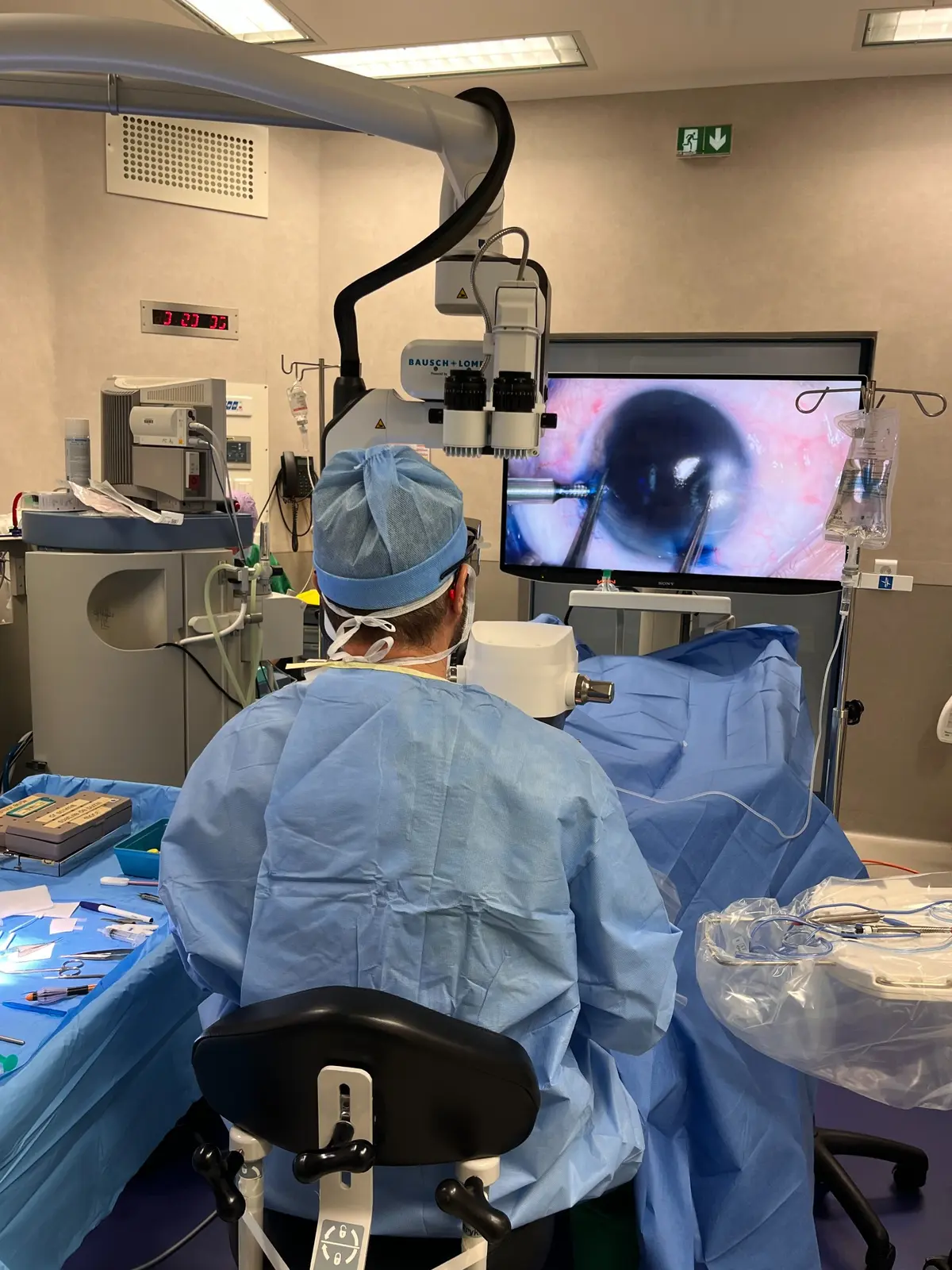
Corneal surgery in an ophthalmic operating theatre
Summary
The choice of technique depends on the affected corneal layer, endothelial status, corneal geometry and functional goals. When appropriate, femtosecond laser cutting allows the depth and geometry of tissue planes to be programmed precisely. It does not replace every manual technique, and its value is assessed case by case.
Medical information
Principles and techniques
01
Full-thickness corneal graft
Penetrating keratoplasty replaces the full thickness of the central cornea with a sutured donor graft. It remains indicated when several corneal layers are affected. Femtosecond cutting can create programmed interlocking profiles; however, studies have not demonstrated systematic superiority for every outcome, particularly astigmatism.
02
Endothelial grafts · UT-DSAEK and DMEK
These procedures selectively replace the posterior cornea when the endothelium fails. UT-DSAEK includes the endothelium, Descemet membrane and an ultra-thin stromal layer. DMEK transplants Descemet membrane and the endothelium.
03
Anterior lamellar graft · ALTK
ALTK replaces an anterior corneal layer while preserving healthy posterior layers. It may be performed manually or with femtosecond laser assistance. In selected superficial indications, accurate tissue planes may allow a sutureless procedure.
04
Deep anterior lamellar graft · DALK / DLK
Deep anterior lamellar keratoplasty replaces diseased stroma while preserving Descemet membrane and the endothelium when they remain healthy. It is used particularly for keratoconus and selected stromal disorders.
05
Bowman layer transplantation
In selected advanced and progressive keratoconus, implantation of a donor Bowman layer within the stroma may reduce or stabilise corneal steepening and defer a more invasive graft. This remains a highly specialised indication.
06
Amniotic membrane graft
Cryopreserved or lyophilised amniotic membrane may provide biological support for healing in selected tissue defects, ulcerations or conjunctival-corneal reconstructions. The form used depends on the clinical situation.
07
Pterygium and ocular-surface reconstruction
A pterygium is a fibrovascular growth of conjunctiva extending onto the cornea. Surgery may combine excision with a conjunctival-limbal autograft. Lyophilised amniotic membrane may supplement reconstruction in selected extensive defects or recurrent cases.
Surgical facility
Polyclinique Saint-Roch Montpellier
Corneal procedures requiring an operating theatre and specialist equipment are performed at Polyclinique Saint-Roch.
A transplant may be discussed when changes in corneal transparency, shape or structure reduce vision and a less invasive treatment is insufficient. The choice between penetrating, anterior lamellar and endothelial transplantation depends mainly on the affected layer.
What is the role of the femtosecond laser in corneal surgery?
When appropriate, the femtosecond laser allows the depth and geometry of selected tissue planes to be programmed precisely. It does not replace every manual technique, and its value is assessed for each cornea.
Where is corneal-transplant surgery performed in Montpellier?
Corneal procedures requiring an operating theatre and specialist equipment are performed at Polyclinique Saint-Roch in Montpellier after assessment and confirmation of the indication.