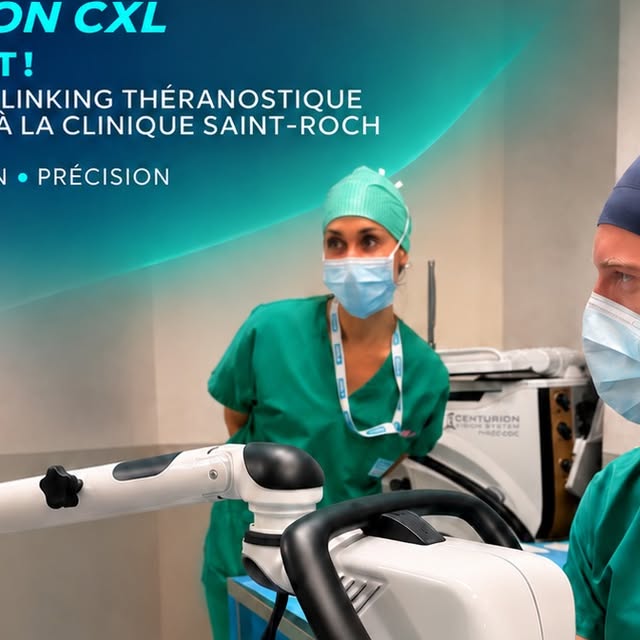
A launch in Montpellier
A post published on 12 November 2026 announces the launch of theranostic cross-linking at Clinique Saint-Roch in Montpellier. This development concerns patients with progressive keratoconus when cross-linking is indicated after an individual corneal assessment.
What the device measures
The device adds optical measurements during the procedure: it estimates corneal riboflavin concentration, monitors UVA-mediated photodegradation and calculates a score intended to describe the effect produced during treatment. This score is a device-specific intraoperative indicator; it does not by itself guarantee keratoconus stabilisation. Stabilisation is assessed by comparing serial corneal topography or tomography. [1–4]
Exclusive use of iontophoresis in my practice
In my practice, cross-linking is performed exclusively with iontophoresis and without epithelial removal. A low-intensity electrical current delivers riboflavin through an intact epithelium. This avoids a central epithelial wound and usually allows a faster return towards the pre-procedure level of vision, without removing other risks or the need for long-term follow-up. [5–7]
A measurement that complements corneal follow-up
Theranostic monitoring therefore complements the assessment performed during treatment; it does not change the indications for cross-linking or the postoperative checks that remain necessary. The detailed medical page explains how the technology works, the published evidence and its limitations.
Sources
Instagram post behind this news item [1] Non-invasive riboflavin measurement — Journal of Biophotonics, 2018 [2] Preclinical evidence for theranostic-guided cross-linking — Journal of Biophotonics, 2022 [3] Multicentre randomised clinical trial — Ophthalmology Science, 2024 [4] Critical discussion of fluorescence-based quantification — Journal of Biophotonics, 2026 [5] Randomised trial of iontophoresis versus standard cross-linking — JCRS, 2019 [6] Five-year iontophoresis outcomes — International Ophthalmology, 2023 [7] Meta-analysis of iontophoresis versus epi-off cross-linking — International Ophthalmology, 2026Frequently asked questions
Does the theranostic score prove that keratoconus has been stabilised?
No. It provides information during the procedure. Stabilisation is subsequently assessed with comparable corneal examinations repeated over time. [3,4]