Correcting vision and monitoring disease
Keratoconus progressively changes the shape of the cornea. This irregularity can produce astigmatism that is difficult to correct with spectacles alone, with distorted vision or multiple images. Management separates two aims: monitoring and, when required, slowing documented progression; and finding the most suitable optical correction. Hybrid lenses, scleral lenses and, in selected situations, a phakic implantable collamer lens (ICL) address the second aim. They do not replace disease monitoring or stabilisation treatment when this is indicated. [1,2]
Start with a comparative corneal assessment
Before choosing a correction, assessment determines refraction, visual acuity, corneal topography or tomography, corneal thickness and change from previous examinations. Progression should be sought, particularly in younger people. When it is confirmed and anatomical criteria are met, corneal cross-linking may be considered to strengthen the cornea. Optical correction is selected alongside or after stabilisation according to the individual situation. [1,2]
Hybrid lens: rigid centre and soft skirt
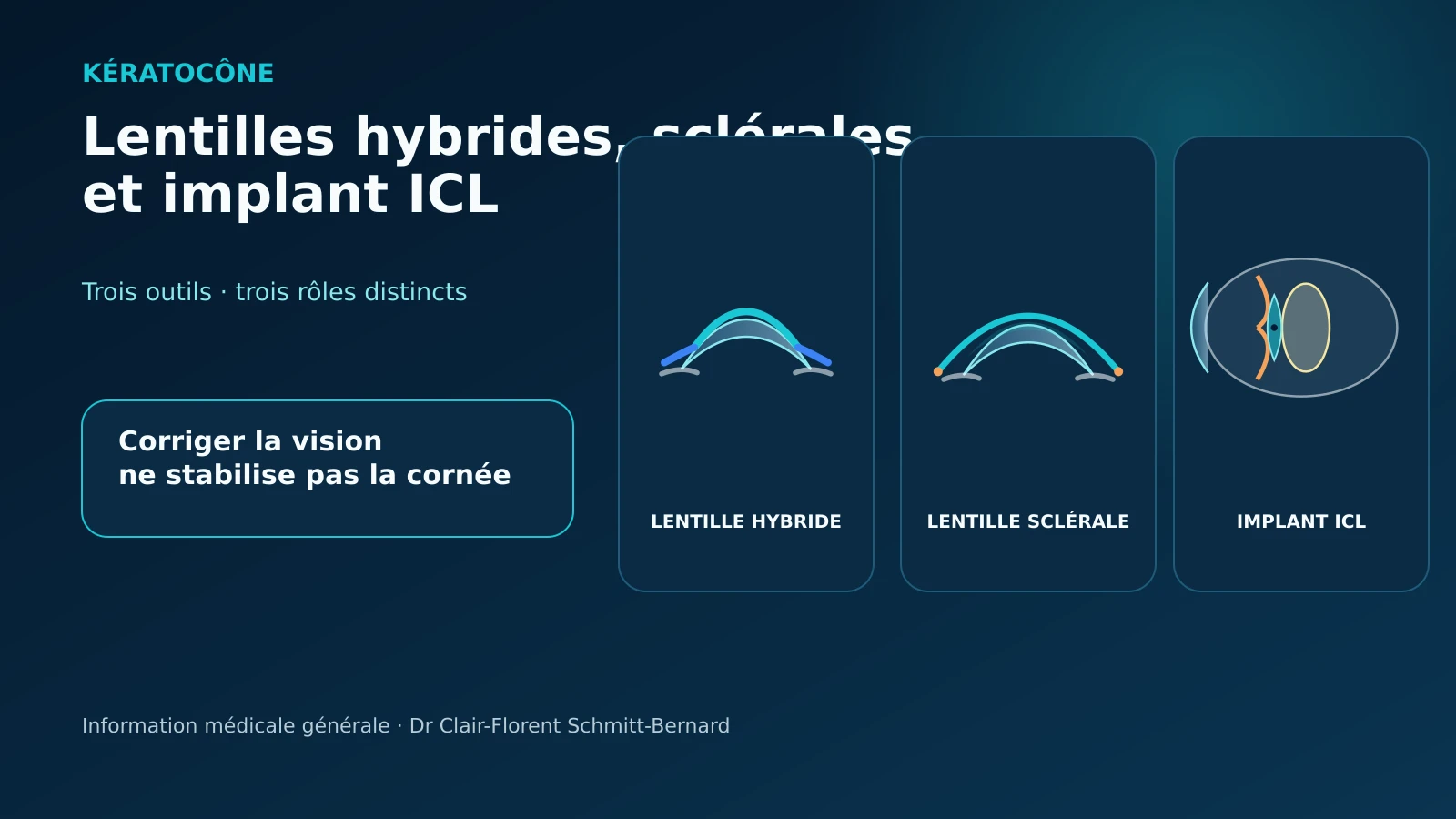
A hybrid lens combines a rigid gas-permeable central zone with a soft peripheral skirt. The rigid centre creates a regular optical surface in front of the cornea; the skirt helps centration and stability. Fitting remains individual: diameter, geometry, movement, centration and visual quality are checked during diagnostic trials. A hybrid lens corrects vision while it is worn but does not alter the structure of keratoconus. [1,3,4]
The available comparative studies are small. A 2023 study of keratoconic eyes found no significant difference in visual acuity between a hybrid lens and a corneal rigid lens, while noting the need for longer follow-up. A second comparison published in 2022 studied hybrid and mini-scleral lenses. These findings do not establish one option as superior for everyone: visual quality, handling, stability and the ocular surface during wear must be assessed individually. [3,4]
Scleral lens: a vault over the cornea
A scleral lens is a large rigid lens that vaults over the cornea and lands on the conjunctiva covering the sclera. Before insertion it is filled with sterile, preservative-free saline. The fluid reservoir between the lens and the cornea helps neutralise anterior corneal irregularity and can improve optical quality. The lens does not, however, slow the progression of keratoconus. [1,2,5]
Scleral fitting checks the space between the lens and cornea, limbal clearance and the distribution of bearing. A French prospective study published in 2024 in 25 eyes found better acuity with both corneal rigid and scleral lenses than with spectacles; in this small sample, higher-order optical aberrations were lower with the scleral lens. These data inform optical performance, but the sample size does not allow the finding to be generalised to every person with keratoconus. Learning insertion, renewing the fluid, lens care and regular reviews are part of the fitting process. [5]
Phakic ICL: a selected indication
An ICL is a phakic lens implanted inside the eye, behind the iris and in front of the natural crystalline lens. It corrects myopia and, with some models, regular astigmatism that falls within the device parameters. It does not remove corneal tissue. In keratoconus, it may be considered for selected people whose disease is documented as stable and whose residual prescription is compatible with the available implant. [1,6,7]
The implant does not regularise corneal shape and may not correct all irregular astigmatism. Additional correction with spectacles or contact lenses may therefore remain useful. A 2025 retrospective study reported one-year outcomes in 86 eyes implanted after prior keratoconus stabilisation. The measured improvement should be interpreted cautiously: the study was not randomised, follow-up was short and the results do not predict an individual outcome. [6]
ICL implantation is intraocular surgery. Assessment must check, among other features, anterior-chamber depth, angle anatomy, eye size and crystalline-lens health. Follow-up monitors intraocular pressure, implant position and clearance, crystalline-lens clarity and the corneal endothelium. The regulatory information lists possible risks including pressure elevation, cataract, rotation of a toric implant and loss of endothelial cells. [7]
How is the choice made?
There is therefore no universal hierarchy among hybrid lenses, scleral lenses and ICLs. Decision-making follows four steps: identify progression; stabilise the cornea when indicated; compare optical corrections through reproducible trials; then assess anatomy, handling ability and follow-up requirements. The choice may change if the cornea, refraction or visual needs change. [1,2]
Distinct aims
The aim is to combine structured corneal monitoring with correction proportionate to the measurements and visual needs. A hybrid or scleral lens is reversible and assessed by a diagnostic trial. An ICL has a narrower indication and requires specific information about surgery and follow-up. In every case, correcting vision is distinct from stabilising keratoconus.
Sources
[1] Global Consensus on Keratoconus and Ectatic Diseases — Cornea, 2026 [2] Evidence-based clinical practice guideline for keratoconus — 2026 [3] Hybrid versus corneal rigid gas-permeable lenses — Eye & Contact Lens, 2023 [4] Hybrid versus mini-scleral lenses — Contact Lens & Anterior Eye, 2022 [5] Scleral versus corneal rigid lenses in keratoconus — European Journal of Ophthalmology, 2024 [6] Toric phakic ICL after keratoconus stabilisation — 2025 [7] FDA — EVO/EVO+ Visian Implantable Collamer Lens, official device informationFrequently asked questions
Do scleral lenses stop keratoconus from progressing?
No. They provide optical correction while worn. Progression is monitored with comparable corneal examinations and may lead to consideration of a separate stabilisation treatment. [1,2]
Is a hybrid lens always preferable to a scleral lens?
No. The available evidence does not identify a universally superior option. The choice is based on trials, visual quality, stability, handling and follow-up. [3,4]
Does an ICL always remove the need for contact lenses?
No. It corrects a compatible prescription but does not regularise the cornea, and some irregular astigmatism may remain. [1,6]
Must keratoconus be stable before an ICL?
Yes. Stability must be documented and the ocular anatomy must meet the device selection criteria. [1,6,7]